expofair goes GREEN!
expofair is very keen to combine the economic and the ecological. That means conserving resources is now part of the daily routine. Timeless design and lightweight construction with high functionality are essential features for durable rental furniture. In-house constructions of transport systems as well as reusable protective covers help our event equipment to retain its value.
We manufacture exclusive and CD-compliant furniture ourselves in our workshops. Attention is paid to every detail here – including the multiple and durable use of materials.
expofair’s broad product/service portfolio enables us to offer our customers a full service in many areas (rental furniture, trade fair and stage construction, decoration construction, workshops…). In detail, this entails less commissioning of service providers at the respective event for our customers. This in turn reduces communication and logistics effort – while transportation is reduced or selectively linked, which in turn reduces costs and emissions.
“The topic of sustainability is and
remains a challenge that requires
a constant rethinking of existing processes.
We grow from that and face it every day.”
Mobility – Vehicle fleet
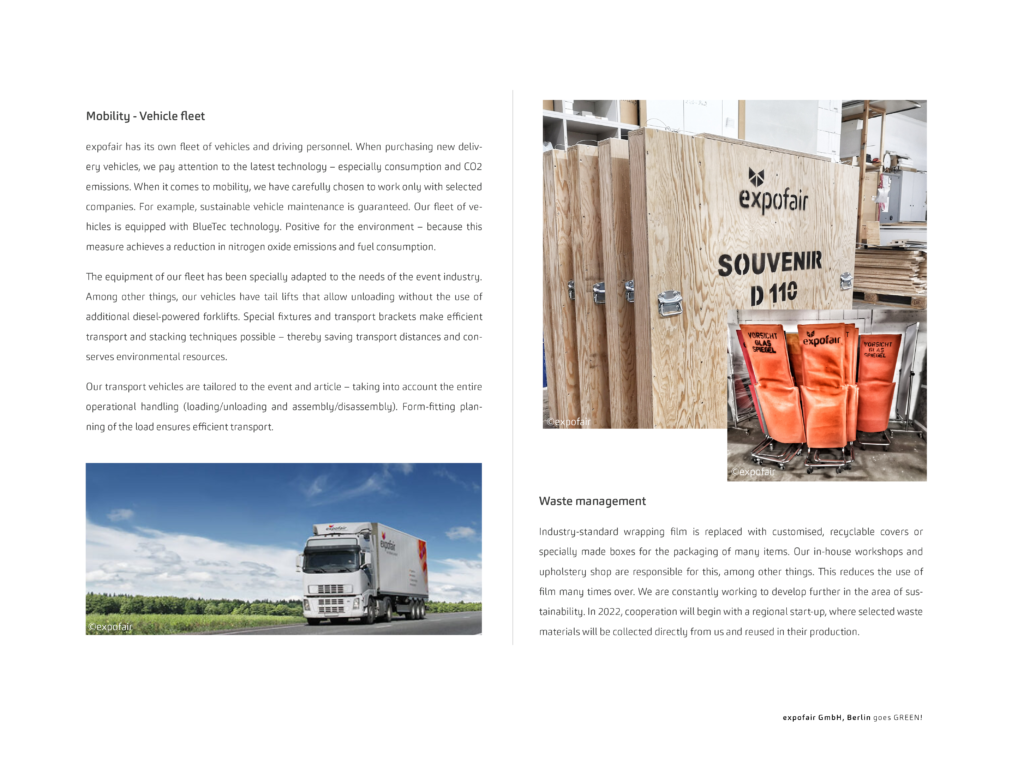
expofair has its own fleet of vehicles and driving personnel. When purchasing new delivery vehicles, we pay attention to the latest technology – especially consumption and CO2 emissions. When it comes to mobility, we have carefully chosen to work only with selected companies. For example, sustainable vehicle maintenance is guaranteed. Our fleet of vehicles is equipped with BlueTec technology. Positive for the environment – because this measure achieves a reduction in nitrogen oxide emissions and fuel consumption.
The equipment of our fleet has been specially adapted to the needs of the event industry. Among other things, our vehicles have tail lifts that allow unloading without the use of additional diesel-powered forklifts. Special fixtures and transport brackets make efficient transport and stacking techniques possible – thereby saving transport distances and conserves environmental resources.
Our transport vehicles are tailored to the event and article – taking into account the entire operational handling (loading/unloading and assembly/disassembly). Form-fitting planning of the load ensures efficient transport.
Service / performance and innovative product development
The special lightweight construction of our furniture (e.g. Modulo bridge table) reduces the load weight and thus decimates fuel consumption. Lightweight construction reduces the transport weight and also saves unnecessary use of raw materials. All our rental furniture is sourced from manufacturers who specialise in durability, guarantee a high standard of quality and act in an environmentally conscious manner.
What is more, expofair rental furniture can be stacked efficiently for the most part – thereby saving internal and external resources, especially transport and storage logistics. Many of our rental items are modular and thus suitable for different applications – resulting in high functionality and multiple use.
Temporary buildings: Here, among other things from an ecological point of view, we opted for “Stand construction with system” and “Stage construction with timber construction”. This allows the material used to be reused as much as possible.
Digitalisation | Communication
expofair is already digitalised in many areas, but is constantly expanding its structures. For example, we are part of the BMWi’s “Digital Now” funding programme. In this programme, all expofair’s work processes are checked by specialised IT and consulting companies for efficiency and digitalisation options – then accompanied during subsequent implementation. Finalisation is planned for 2022.
In the area of communication, expofair relies on the latest technologies. For example, the targeted use of digital filing and CRM systems, digital bookkeeping reduce the use of paper to a minimum.
The latest video conferencing technology and communication tools with partly cloud-based technology save the use of additional servers, thus reducing superfluous electrical waste and cutting power consumption.
Waste management
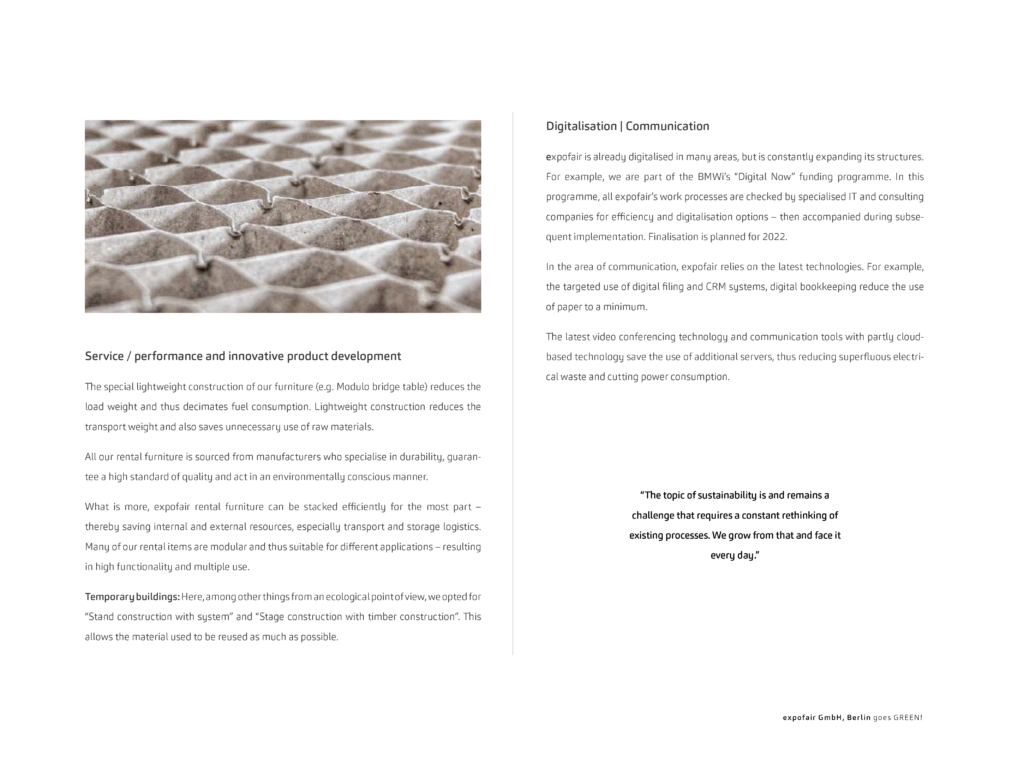
Industry-standard wrapping film is replaced with customised, recyclable covers or specially made boxes for the packaging of many items. Our in-house workshops and upholstery shop are responsible for this, among other things. This reduces the use of film many times over. We are constantly working to develop further in the area of sustainability.
In 2022, cooperation will begin with a regional start-up, where selected waste materials will be collected directly from us and reused in their production.